
Bay Area Sauna Building Codes & Permits: What You Need to Know
Building a sauna in the San Francisco Bay Area involves more than choosing the right wood and heater. Local building departments enforce specific codes for ventilation, electrical, fire safety, and setbacks — and the requirements vary by municipality. Here is a practical overview based on our experience with permitting across the region.
Do You Need a Permit?
In almost all Bay Area jurisdictions, the answer is yes for any permanently installed sauna that involves electrical work. San Mateo County, San Francisco, and most Peninsula cities require a building permit for sauna installations. The permit ensures your project meets California Building Code (CBC) and local amendments for fire safety, electrical safety, and structural adequacy.
Pre-built, plug-in sauna units that operate on a standard 120V outlet may be exempt in some jurisdictions, but custom-built saunas with hardwired heaters (240V) always require permits.
Electrical Requirements
Most sauna heaters require a dedicated 240V circuit with the appropriate amperage (typically 30–60 amps depending on heater size). The circuit must include a disconnect switch visible from the sauna entrance, per NEC Article 680 (which covers similar wet-area installations). All wiring within the sauna room must be rated for high-temperature environments — standard Romex is not acceptable above the insulation line.
Ventilation and Fire Safety
The CBC requires mechanical or passive ventilation capable of providing adequate air exchange. Combustible materials must maintain specific clearances from the heater — typically 4–6 inches for UL-listed electric heaters. Ceiling height is generally limited to 7 feet in the sauna room to prevent excessive heat stratification and reduce heater workload.
Outdoor Sauna Setbacks
If you are building a standalone outdoor sauna, setback requirements apply. In San Mateo County, accessory structures typically must maintain a 5-foot setback from side and rear property lines. San Francisco has its own zoning code with different rules depending on the district. Some HOAs impose additional restrictions on outbuilding size, height, and placement — always check your CC&Rs before finalizing a design.
The Permit Process
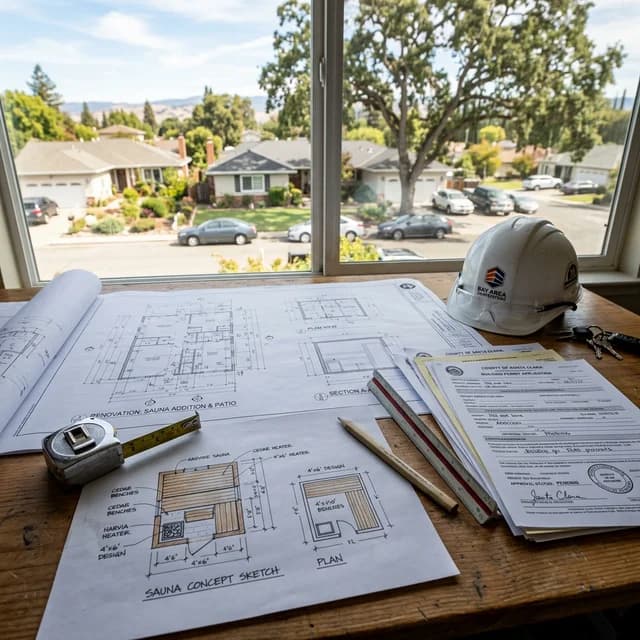
A typical residential sauna permit in the Bay Area takes 2–4 weeks for plan review. The submission usually requires: a site plan showing the sauna location, floor plans with dimensions, electrical plans showing the dedicated circuit, and details on ventilation and materials. After construction, an electrical inspection and final building inspection are standard.
How We Handle Permits
At RP Restoration, we manage the entire permitting process for our clients. Our in-house design team prepares permit-ready drawings, we submit the application, respond to any plan check comments, and coordinate all required inspections. You don't have to set foot in a building department — that's part of our end-to-end service promise.
Ready to Build Your Dream Sauna?
Schedule a free consultation and let's discuss your project.